
The Evolution of the Analytics Department
Ten years ago, the "Analytics Department" at a professional sports club was often just a single coach parsing through spreadsheets of distance-covered metrics. Today, the landscape has radically transformed.
At the highest echelons of football (soccer), basketball, and American football, elite clubs operate like elite tech companies. They employ full-time Data Scientists, Machine Learning Architects, and Computer Vision specialists.
These departments are tasked with a monumental challenge: turning unstructured, raw match footage into immediately actionable tactical intelligence.
While generalized software can tell a manager how far a player ran, it cannot explain why a defensive block collapsed or how an athlete's sprint biomechanics are causing micro-tears in their hamstring. To answer these deep, championship-deciding questions, professional clubs are leveraging advanced Computer Vision across three critical pillars.
 Modern Heads of Performance are utilizing augmented reality and computer vision to visualize pitch dominance and passing networks directly from raw footage.
1. Tactical Performance Logs
Standard event data (counting passes, shots, and tackles) provides an incomplete picture of a match. It fails to capture the "off-the-ball" movement that dictates elite tactical systems.
To understand true spatial dominance, clubs are utilizing heavy computer vision tracking algorithms to generate Tactical Performance Logs.
How Computer Vision Powers Tactics
By deploying multi-person tracking algorithms over tactical broadcast feeds, clubs can calculate:
- Pitch Control Models: Mapping the exact geometric area a team dominates using Voronoi diagrams generated from precise player coordinates.
- Defensive Line Integrity: Calculating the millimeter variance in distance between the back four defenders during transition phases.
The Data Bottleneck: Generating tactical logs requires flawless 2D tracking. If a deep occlusion event occurs (e.g., a massive scramble in the penalty box) and the automated tracking algorithm drops a player's ID, the entire pitch control model collapses. Elite clubs require 100% continuous tracking, mandating the use of human-in-the-loop (HITL) annotation to correct algorithmic drift on the fly.
2. Scouting Intelligence
The transfer market is a multi-billion dollar casino. To mitigate risk, Chief Scouts can no longer rely solely on the "eye test." They require granular, objective data on a player's physical and technical output before authorizing a $50 million transfer fee.
AI-Augmented Scouting
Computer Vision is revolutionizing Scouting Intelligence by allowing clubs to extract deep performance metrics from standard television broadcast feeds of obscure foreign leagues. Even without specialized stadium sensors, CV models can track:
- Burst Velocity: Calculating a winger's exact acceleration curve during the first 5 meters of a sprint.
- Gaze Tracking: Utilizing advanced pose estimation to determine field-scanning frequency (how often a midfielder checks their shoulder before receiving a pass).
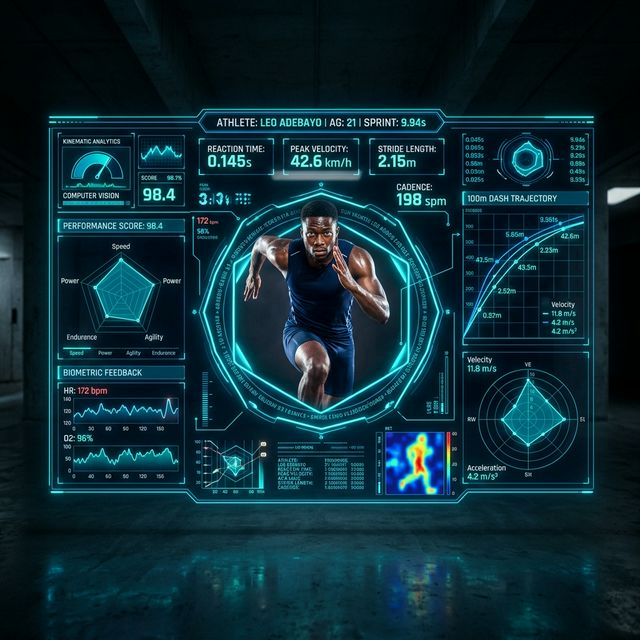 AI-driven Scouting Intelligence dashboards process raw broadcast video into objective, comparable physical performance metrics, removing human bias from the transfer market.
The Data Bottleneck: To extract physical metrics from low-angle broadcast TV, the computer vision models must be trained to ignore extreme camera panning, wide-angle lens distortion, and poor lighting. This requires massive, highly specialized Ground Truth datasets annotated specifically to teach neural networks how to handle broadcast noise.
3. Biomechanical Audits
Perhaps the most exciting application of computer vision within professional clubs is the Biomechanical Audit.
When a star player tears their ACL or suffers chronic hamstring issues, the club loses millions in sunk wages and potential points. Medical departments are now treating injury prevention as a strict data science problem.
Marker-less Motion Capture
Rather than flying a player to a specialized facility to wear ping-pong ball tracking suits, clubs are using standard 4K cameras placed around the training pitch. By running Multi-Person Pose Estimation (MPPE) algorithms over the footage, the medical team can generate a 33-point skeletal wireframe of the athlete's body.
They use this wireframe to conduct a Biomechanical Audit, identifying:
- Asymmetrical Loading: Are they favoring their left knee during deceleration?
- Form Degradation: Is their stride length collapsing during the final 15 minutes of an intense drill?
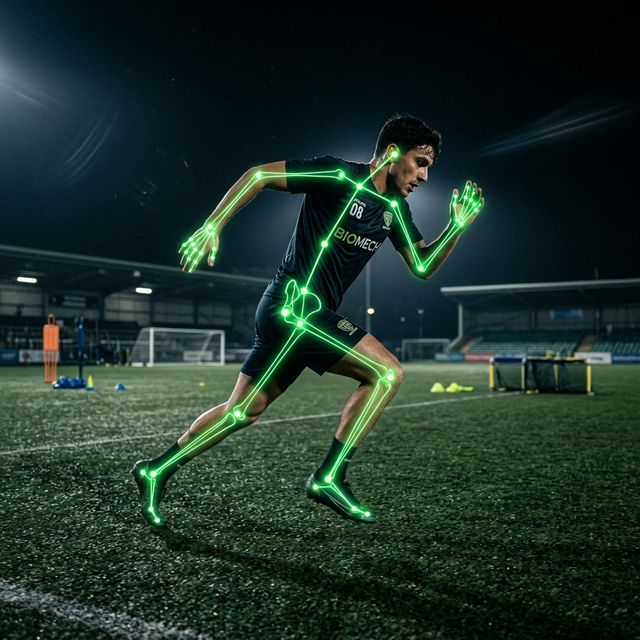 Biomechanical Audits utilize dense 33-point skeletal tracking algorithms to identify dangerous asymmetries and prevent catastrophic soft-tissue injuries.
The Data Bottleneck: Skeletal tracking is the hardest annotation task in computer vision. It requires annotators to possess deep anatomical knowledge to accurately place joints on a player whose body is contorted or motion-blurred mid-sprint. An algorithm is only as good as the human who mapped the skeleton.
Empowering Elite Analytics at Train Matricx
For the Data Science departments at top-tier Professional Clubs, internal resources are incredibly tight. Machine Learning Architects should not be spending their weeks manually tracking bounding boxes or auditing an auto-labeler's mistakes.
To achieve the highest fidelity Tactical Logs, Scouting Intelligence, and Biomechanical Audits, elite clubs partner directly with Train Matricx.
We don't crowdsource. We deploy managed teams of domain-expert annotators—specialists who understand the offside construct, the mechanics of a sprint, and the geometry of a high-press system. We plug directly into your internal AI platforms to provide the pure, human-verified Ground Truth data required to give your club the ultimate competitive edge.
Stop guessing. Start calculating.
If you manage analytics or data science for a Professional Sports Club, Book a Technical Scoping Call with Train Matricx today to streamline your data pipeline.
Authored By
Asif Ikbal